What you can do in the platform
The hosted platform is the saved view generated from the latest completed run: pick any problem, read the exact generated program for each model and seed, see its judge outcome case by case, switch to the "after mechanical syntax repair" interpretation, watch recorded neuron activity on the fly avatar, and read the training curves. Starting a new experiment needs the local server and the 500 MB mapped graph (./flycodes.sh serve).
The result
| Model | Fresh MBPP subset | Unseen constants | Seen training | Readout params |
|---|---|---|---|---|
| Fly · seed 7 | 0 / 24 | 0 / 30 | 1 / 8 | 1,325,544 |
| Fly · seed 19 | 0 / 24 | 0 / 30 | 0 / 8 | 1,325,544 |
| No recurrence · seed 7 | 0 / 24 | 0 / 30 | 1 / 8 | 1,325,544 |
| No recurrence · seed 19 | 0 / 24 | 0 / 30 | 0 / 8 | 1,325,544 |
Training loss fell from 6.6 to 0.03 while validation loss bottomed out at step 100 and then climbed: the readout memorised the corpus. The one passing program is a reproduction of a seen training example (return sum(nums) + 0). A post-run audit with stronger tests removed three false-positive transfer passes per seed-19 model that had used wrong constants; both the original and corrected scores are retained. Mechanical syntax repair made 25 outputs runnable and produced one more seen-training pass, no new-task success.
The earlier pilot (v1, 12 training exercises) scored 0/6 on the six original LeetCode-style problems, as did the no-recurrence control and a tiny Transformer. A pretrained LLM reference was planned and deferred; its blank score is not a zero.
Why, measured
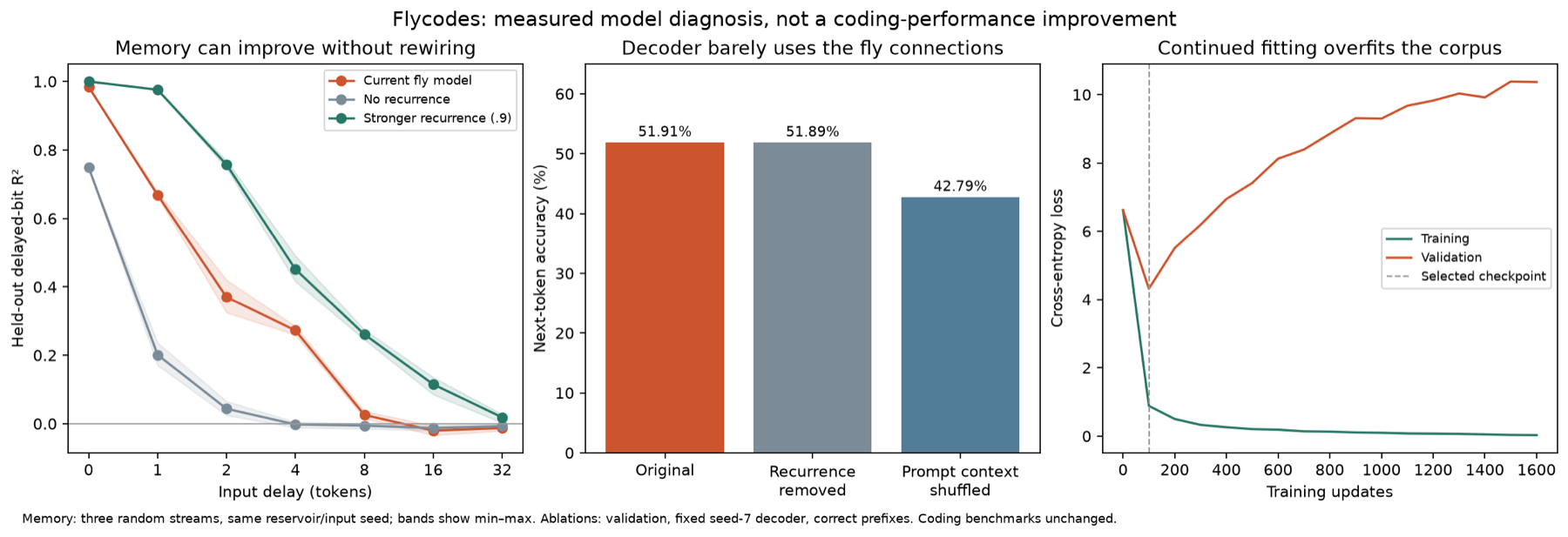
- The readout barely uses the fly connections. Removing the recurrence changes next-token accuracy from 51.91% to 51.89%; shuffling the prompt context drops it to 42.79%. The readout leans on the artificial prompt memory, not the reservoir.
- Memory can improve without rewiring. On a separate delayed-bit task across three random streams, raising the recurrent gain toward 0.9 extended the held-out memory horizon, with no edge changed.
- Continued fitting overfits. Validation loss rises monotonically after the selected checkpoint.
The proposes fixed-topology dynamics learning and staged primitive-to-program evaluations, with references. The current core has no trainable synaptic weights; whether a different fly-constrained architecture could learn broad algorithmic reasoning is an open question this study cannot settle.
How it was set up
- Graph. Every Traced neuron including isolated ones; every positive-count edge including weak edges and 101 self-connections. No subsampling, no threshold.
nodes.tsvmaps array indices to exact body IDs; the manifest records hashes and source URLs. - Dynamics. A calibrated reservoir (recurrent target spectral radius 0.045, leak 0.5, input scale 0.35, chosen on validation only), retained prompt context, a lossless lexical tokenizer and a nonlinear readout. The fly and the control share the same prompt memory, clock features, tokenizer and head; the control removes the recurrence.
- Data. MBPP at a pinned immutable commit with SHA-256 and original task IDs; 246 verified training examples, 60 validation, a 24-task sample from the 209 judge-compatible records fixed before training, and 30 authored unseen-constant exercises. Exclusions are recorded.
- Judge. Generated code is parsed and interpreted in a bounded Python subset in a timed subprocess, never passed to
exec. Unsupported syntax, timeouts, runtime errors and harness errors stay distinguishable. The subset means the score must not be called a full MBPP score.
Run it locally
cd projects/flycodes
python3.12 -m venv .venv && .venv/bin/pip install -r requirements.lock
./flycodes.sh prepare                 # maps the full graph from ../../data/flat-connectome (~500 MB)
./flycodes.sh prepare-curriculum && ./flycodes.sh train-curriculum
./flycodes.sh serve                   # http://127.0.0.1:8765, live platform
.venv/bin/python scripts/export_snapshot.py   # regenerates the self-contained flycodes.html