The explorer
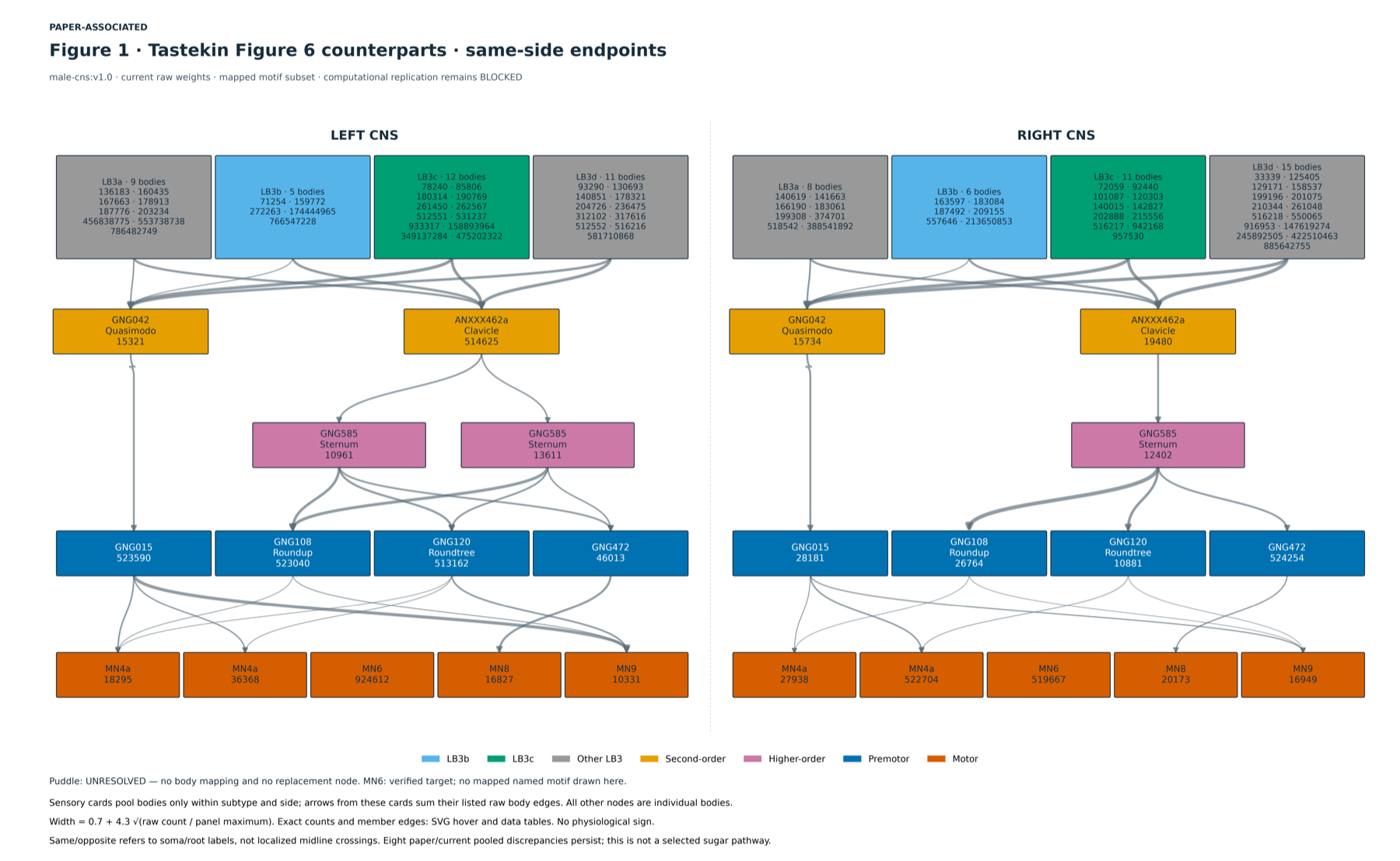
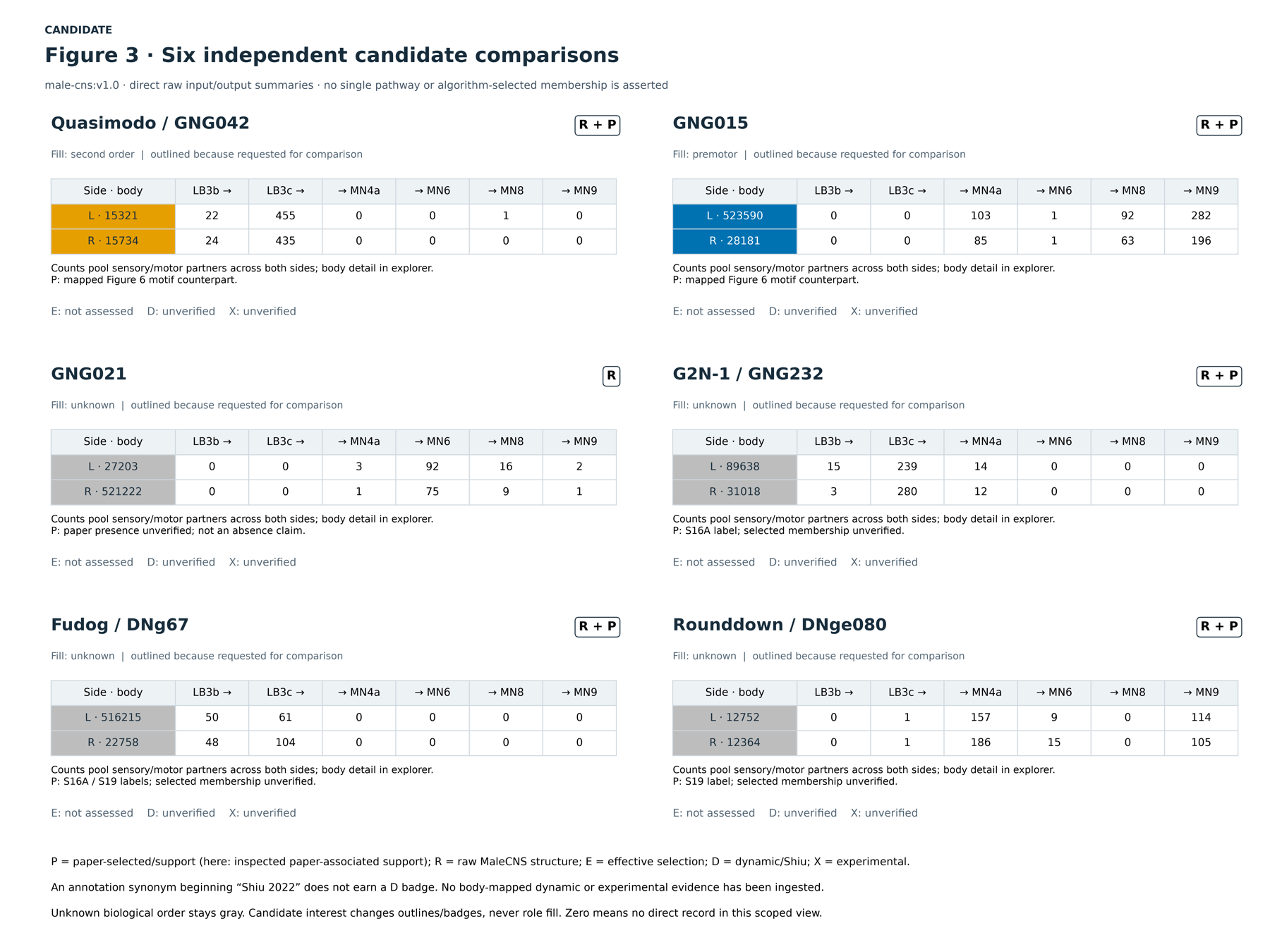
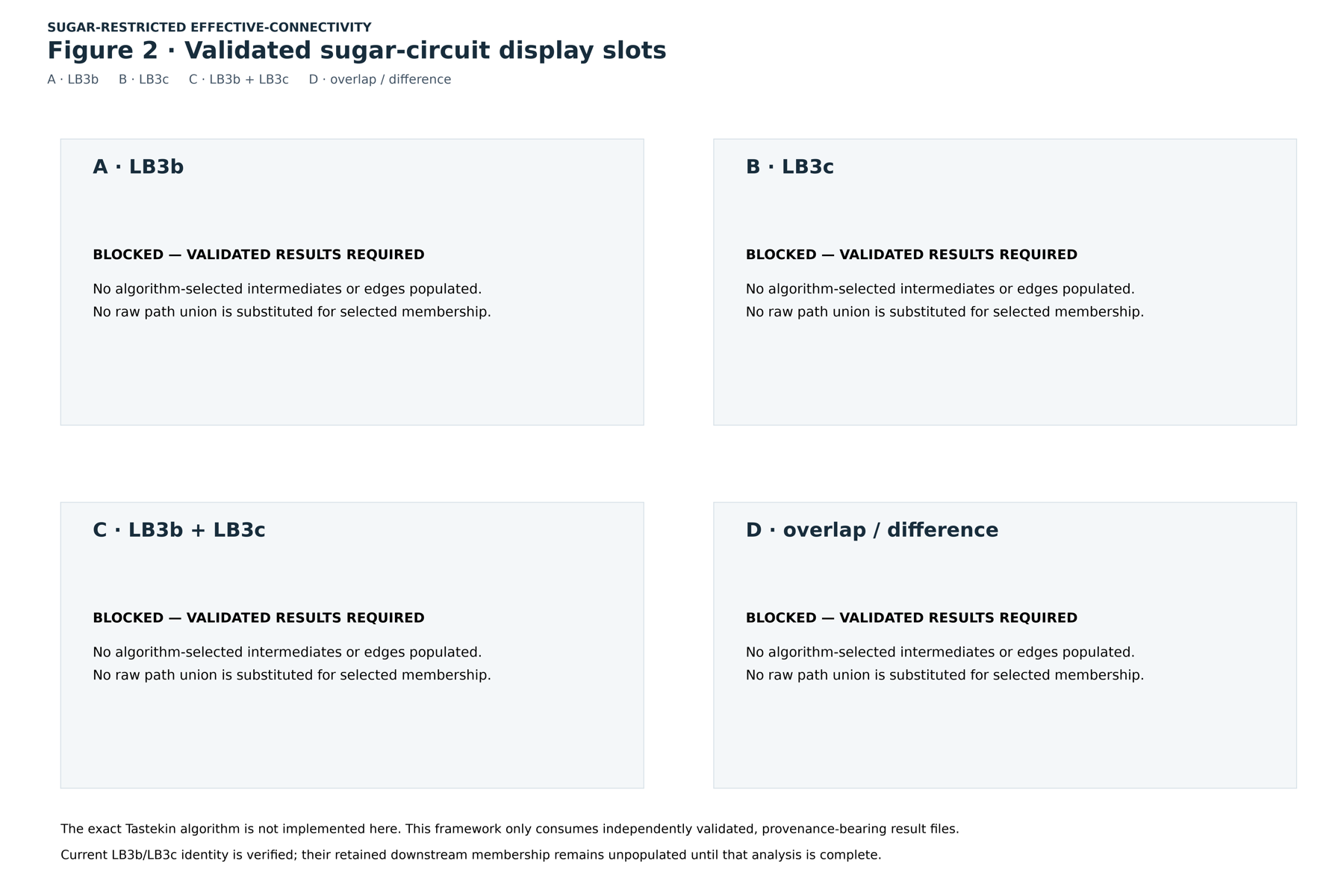
The hosted explorer is a single self-contained HTML file built from the frozen structural run. Choose the raw, paper-associated or candidate-comparison view; filter LB3b, LB3c and other LB3 inputs, the requested candidates, the motor types, evidence badges and sides; click any node for its raw weights, separate transmitter prediction fields, side provenance and evidence status. Edge width is 0.7 + 4.3·√(count / visible max) and the minimum-count slider is display-only. Above 260 visible edges the explorer withholds arrows and keeps the full table. Effective-score mode shows an explicit "unavailable" message rather than falling back to raw counts, because no validated selection exists yet.
What was found
- Identities. Authenticated v1.0 metadata verified; 95 target bodies resolved and cross-checked against the official flat files; all 87 sensory and motor IDs and types corroborated with the paper's Table S1. 1,615 exact cross-representation field matches and 190 explained precision differences.
- Structure. The full released graph retained with no added synapse threshold. All 746,910 exported raw edge weights agree with authenticated neuPrint. All 770 sensory–motor pairs are reachable in 2–3 hops. GNG021 has no direct LB3 input, but all 154 LB3-candidate pairs have shortest length 2 and both candidate bodies reach every motor.
- Discrepancies. Eight pooled paper-versus-current count differences on Figure 6 edges (for example GNG015→MN9: 473 in the paper, 478 in v1.0), one LB3c body (957530) whose entry nerve is missing in v1.0 versus Table S1, and the neuron "Puddle", named in the paper with no body or type mapping in any inspected authoritative record. 976 neurotransmitter field distinctions are preserved as distinctions between supplied fields, not as disagreements.
- Method recovery. The paper's effective-connectivity algebra is reconstructed as far as the final STAR Methods allow; a synthetic audit shows that reference, pooling and horizon choices change membership, so selection remains underdetermined and computational replication is BLOCKED rather than approximated.
| Figure 6 edge | Paper | MaleCNS v1.0 | Ledger |
|---|---|---|---|
| GNG015 → MN9 | 473 | 478 | M290 |
| ANXXX462a → GNG585 | 179 | 178 | M291 |
| GNG585 → GNG120 | 359 | 350 | M292 |
| GNG108 → MN9 | 376 | 381 | M293 |
| GNG108 → MN4a | 98 | 135 | M294 |
| GNG120 → MN9 | 441 | 443 | M295 |
| GNG120 → MN4a | 89 | 98 | M296 |
| GNG472 → MN8 | 205 | 221 | M297 |
Both values retained; neuPrint and flat weights agree with each other; whole-body or whole-edge pruning alone does not explain the differences (M1275–M1282).
How it was done
A written research protocol (v0.1, 6 October 2026) came first. Work then proceeded through gates: an initial validation checkpoint (identities and sources), then a structural-connectivity checkpoint (gates 2 and 3), each ending with an artifact-integrity check that re-hashes every source, input and output, scans for credentials, and verifies local links. Source downloads and raw queries carry provenance logs; earlier results are never overwritten, only superseded by new timestamped directories. The three experiments the paper suggests are drafted as configs and deliberately not run: the method gaps above would make any "replication" a guess. Anatomy is likewise marked BLOCKED (0 of 110 requested skeletons in this build) and a status image named anatomy_BLOCKED stands where a morphology render would go.
Run it locally
cd projects/sugar-circuit
python3.12 -m venv .venv && .venv/bin/pip install -r requirements-validation.txt -r requirements-structural.txt
.venv/bin/python scripts/04_resolve_neuron_ids.py            # compares saved primary records, writes a timestamped result dir
MPLCONFIGDIR=/tmp/mpl .venv/bin/python visualization/scripts/build.py   # rebuilds figures + explorer from the frozen run
.venv/bin/python visualization/scripts/validate.py
The frozen structural results (several GB of edge tables and distance arrays) and the raw data are not in the repository; the explorer, figures, build manifests, ledgers and the validation result directory are.