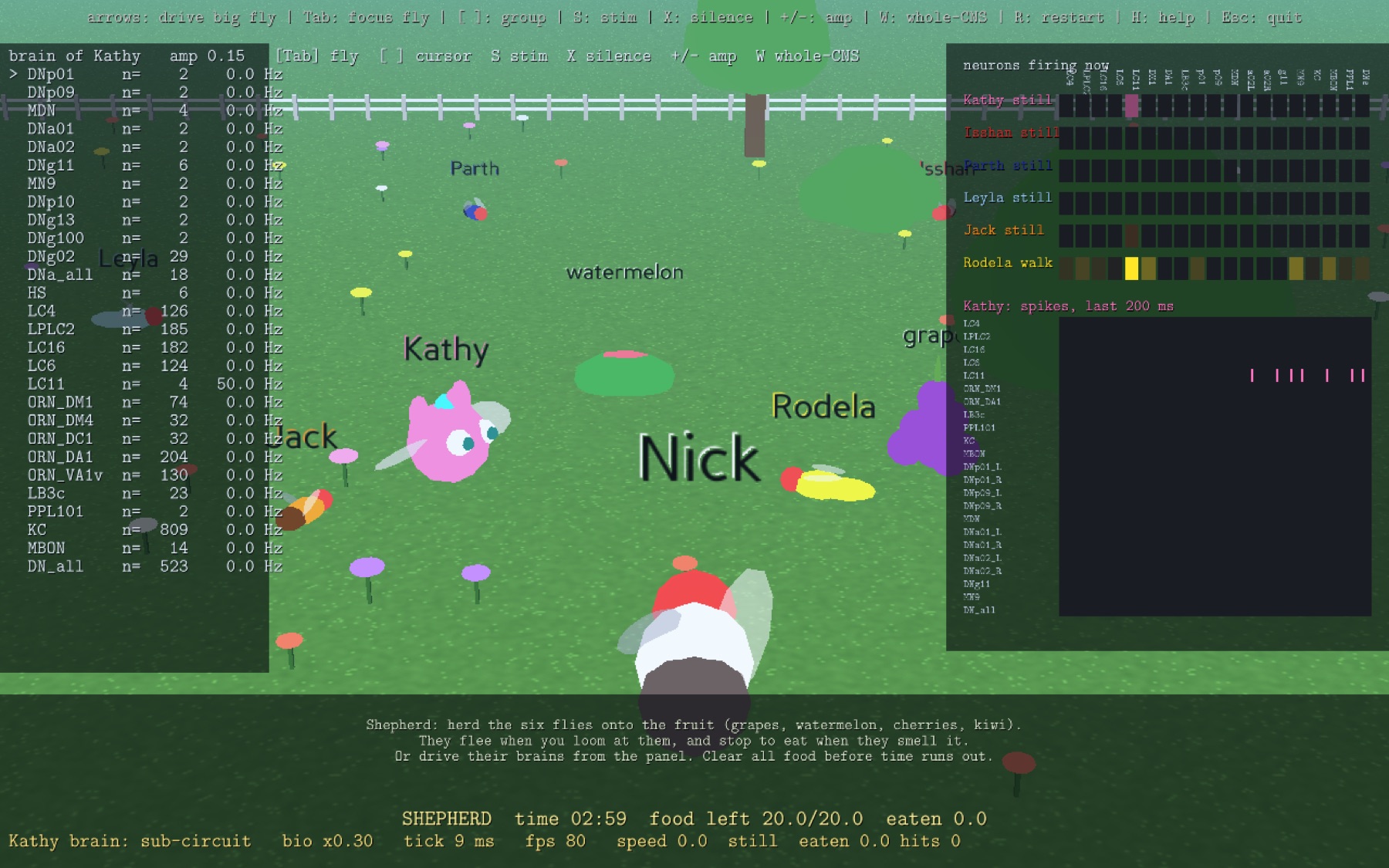
3D chase camera. Left: every neuron group of the selected fly with its firing rate. Right: one LED row per fly, and a 200 ms spike raster of the selected fly.
The brain, in your browser
This is the same circuit the small flies run on, ported from the game's brain.py and decoder.py to JavaScript and stepped on one thread of your browser. Stimulate a group and watch what reaches the descending neurons; silence one and watch a behaviour disappear. The little fly on the right moves according to the decoded descending-neuron output, exactly as the game decodes it.
neuron groupsn · Hz · stim / silence
spikesper group, last 200 ms
Things to try
- Loom left. An object approaches from the front-left over 0.6 s. LC4/LPLC2/LC16/LC6 fire, the giant fiber DNp01 spikes within about 9 ms, and the decoder calls a jump away from the threat.
- Stimulate DNp09. Forward walking at about 100 Hz. Notice DNa02_L fires too: a walk-coupled asymmetry the circuit produces, which calibration measures and the decoder removes.
- Stimulate DNp09, then silence DNa02. The fly still walks but can no longer steer.
- Food odour, then On food. Odour (ORN_DM1) drives the proboscis motor neuron MN9 and suppresses walking; standing on food (LB3c) adds taste. In the game this is why a fly stops on a patch and eats.
- MDN. Backward walking. DNg11. Grooming, with hysteresis.
Playing the desktop game
Shepherd mode: get the six flies to eat all four fruit patches (20 units of food) before the three-minute timer runs out. You have two tools, both of which go through the flies' real circuits.
- Loom at them. Walk the big fly at a small fly. Its looming detectors fire the giant fiber and it jumps away. Approach from the side opposite the food to push it there.
- Drive their brains. Select a fly, put the cursor on DNp09 and press S: it walks forward. DNa02 left or right makes it turn. MDN backs it up.
Within about two units of food, odour shuts down walking and drives MN9, so the fly stops on the patch and eats. That stop-when-you-smell-food behaviour is the circuit's own.
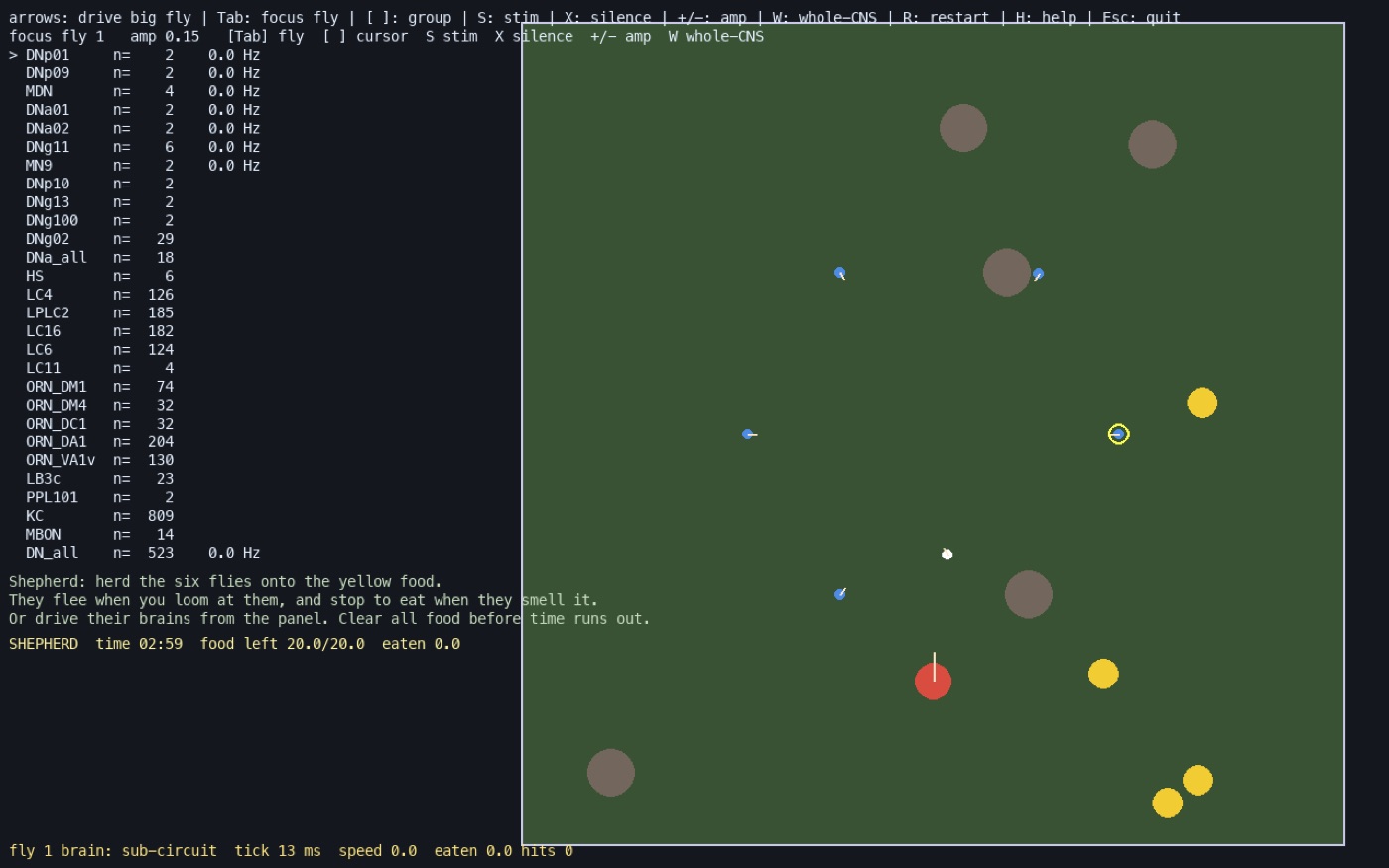
--renderer pygame). LC4 and LPLC2 stimulated: DNp01 at 210 Hz, the fly jumps.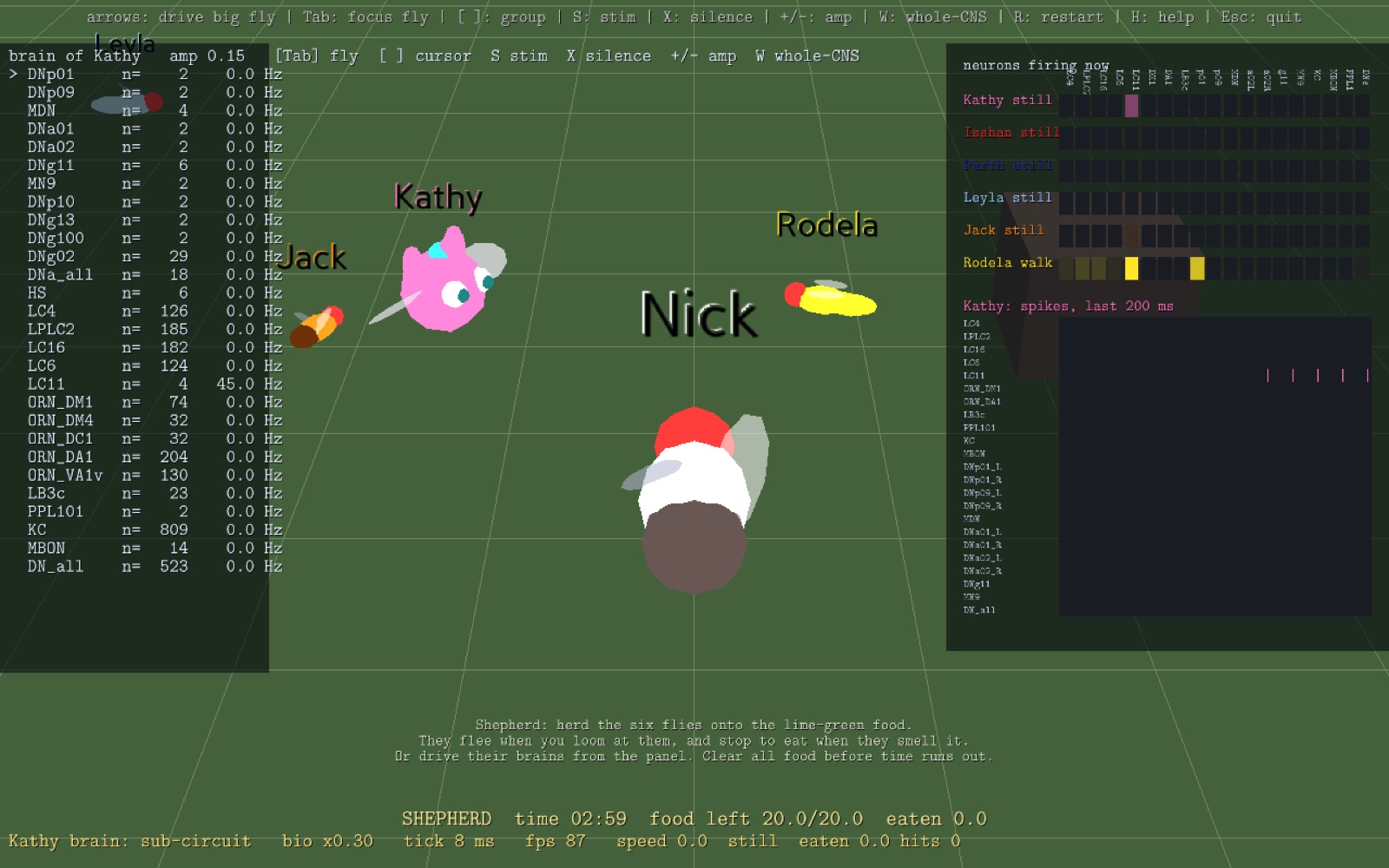
How it works
- Extraction. From the whole traced connectome, keep edges with at least five synapses and every neuron on a path of at most three hops from the looming cells (four from odour and taste cells) to the target descending neurons, excluding optic-lobe columnar cells. Result: 10,203 neurons and 401,680 edges. The whole-CNS option uses all 165,122 traced neurons.
- Dynamics. A batched leaky integrate-and-fire model: 1 ms steps, 20 ms membrane time constant, 2 ms refractory period, synapse count × transmitter sign as the weight, gain 0.005. Propagation is event-driven, so cost scales with activity (1 to 3% of cells). Six sub-circuit brains step together at about 2,500 steps/s on Apple MPS at rest; the whole CNS at about 600.
- Encoders. Angular expansion of an approaching object drives LC4 and LC6; angular size drives LPLC2 and LC16; food odour decays with distance onto ORN_DM1/DM4/DC1; standing on food drives LB3c.
- Decoder. DNp09 (forward), MDN (backward), DNa02/DNa01 left minus right (turning), DNp01 (jump), DNg11 (groom), MN9 (eat), with hysteresis and a calibrated correction for the walk-coupled turning asymmetry.
- Calibration. A sweep over gain and amplitude picks a point where rest is silent, DNp09 stimulation walks without recruiting more than 50 descending neurons, and looming reaches DNp01 within 20 ms. The measured latency is 9 ms.
| Stimulus (calibration) | DNp01 L / R | DNp09 | MDN | MN9 | active cells |
|---|---|---|---|---|---|
| rest | 0 / 0 | 0 | 0 | 0 | 0.00% |
| loom (both sides) | 325 / 310 Hz | 0 | 0 | 0 | 0.83% |
| LC4 right only | 175 / 310 Hz | 0 | 0 | 0 | 0.30% |
| stimulate DNp09 | 0 / 0 | 97.5 Hz | 0 | 0 | 0.03% |
| stimulate MDN | 0 / 0 | 0 | 106 Hz | 0 | 0.03% |
| food odour (ORN_DM1) | 0 / 0 | 0 | 0 | 92.5 Hz | 1.85% |
| taste (LB3c) | 0 / 0 | 0 | 0 | 32.5 Hz | 0.14% |
From processed/calibration.json. Rates are mean per-neuron firing over a 50 ms window; "active" is the fraction of the 10,203 cells spiking per step.
Limits
Odour does not steer the flies toward food through this circuit (it drives MN9 and suppresses walking instead), which is why the player has to bring them there. The brains run at 0.3× biological speed relative to the wall clock in the game (10 ms of brain per 33 ms frame); the browser port above runs at 1× by default. There is no plasticity. Synapse counts are used as weights with a predicted transmitter sign; that is a structural proxy, not measured physiology. "Wander" is the one scripted behaviour: after two seconds of brain silence a fly drifts slowly so it does not look dead.
Run it locally
Needs the MaleCNS v1.0 flat files (about 1.1 GB, from Janelia) in data/flat-connectome/, Python 3.12 and a GPU-capable torch (MPS or CUDA; CPU works but slower).
cd projects/flyworld-game
python -m venv .venv && .venv/bin/pip install torch numpy pyarrow panda3d==1.10.16 pygame-ce pytest
.venv/bin/python scripts/extract_circuits.py --verify   # builds processed/circuit_npc.npz (shipped)
.venv/bin/python scripts/calibrate.py                   # writes processed/calibration.json (shipped)
.venv/bin/python -m flyworld.game                       # 3D chase camera
.venv/bin/python -m flyworld.game --renderer pygame     # top-down view
.venv/bin/python -m flyworld.game --headless --script "focus 2; isolate; stim DNp09; run 150; assert rate DNp09 >= 50; report"
The extracted circuit, calibration and group tables are included in the repository, so the game runs without the raw download; only re-extraction needs it. The verification ledger is in GATES.md: eight gates from environment to scripted behaviour, each with its check command and recorded evidence.