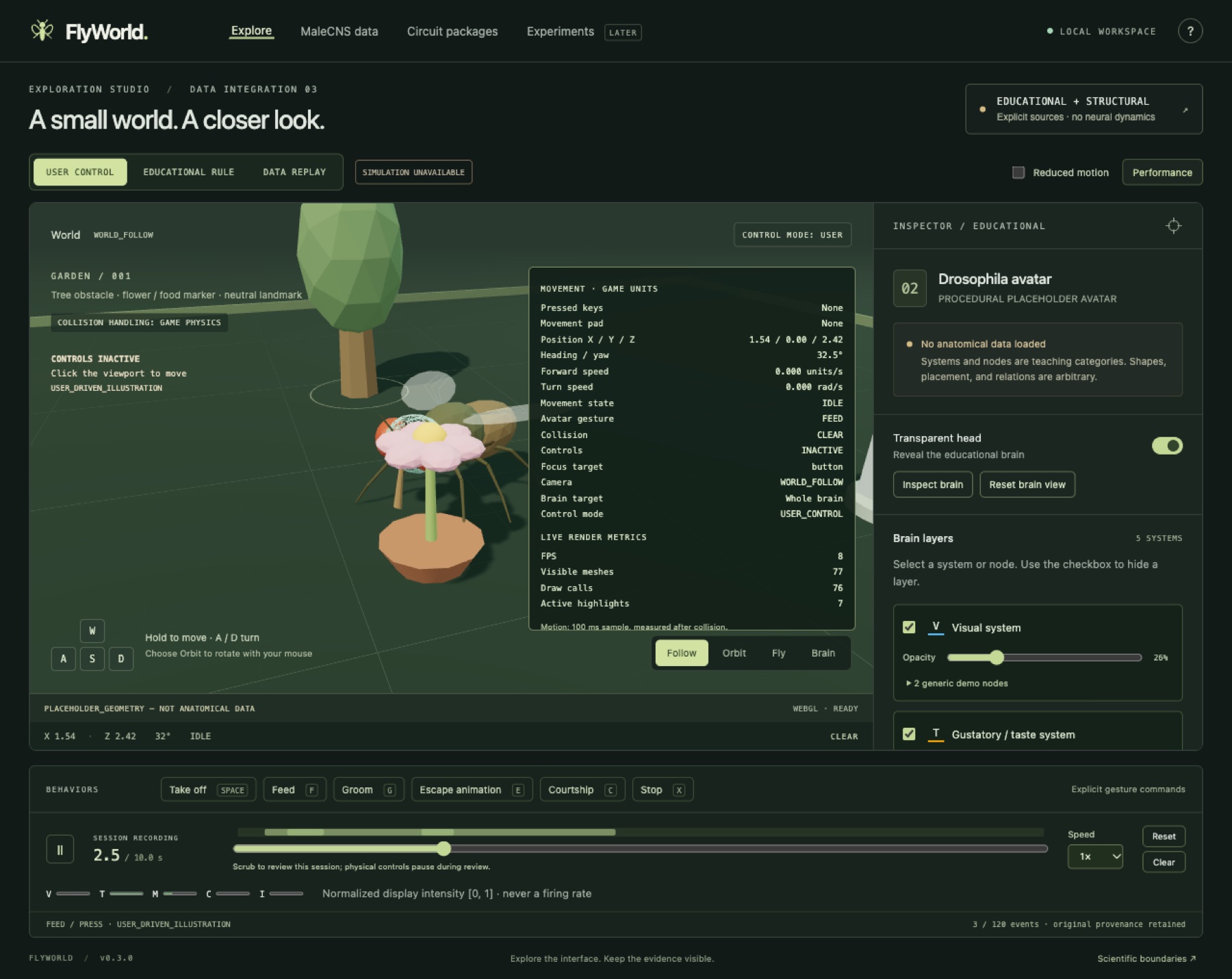
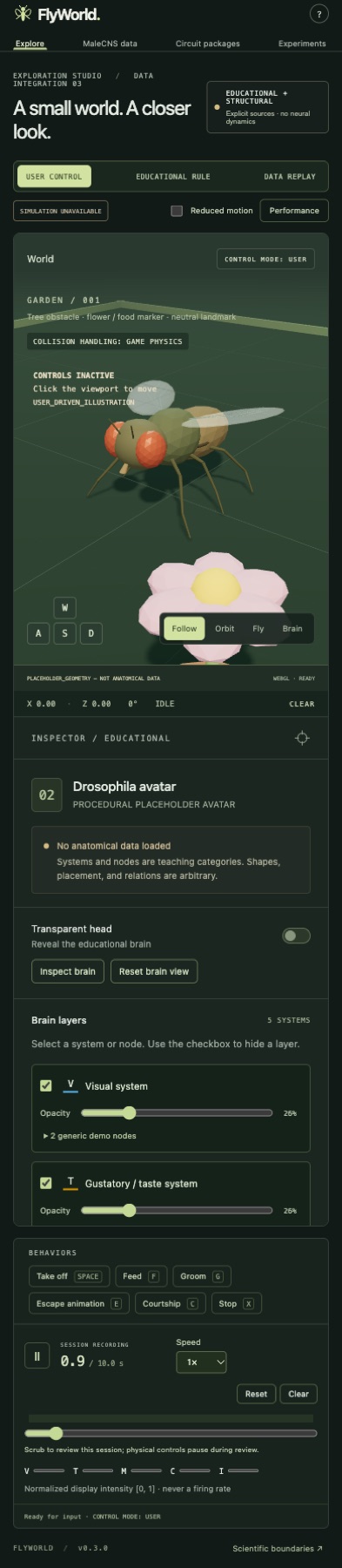
Explore mode. Every overlay is labelled USER_DRIVEN_ILLUSTRATION or RULE_DRIVEN_EDUCATIONAL; the status bar says PLACEHOLDER_GEOMETRY — NOT ANATOMICAL DATA.
What to do in it
Explore
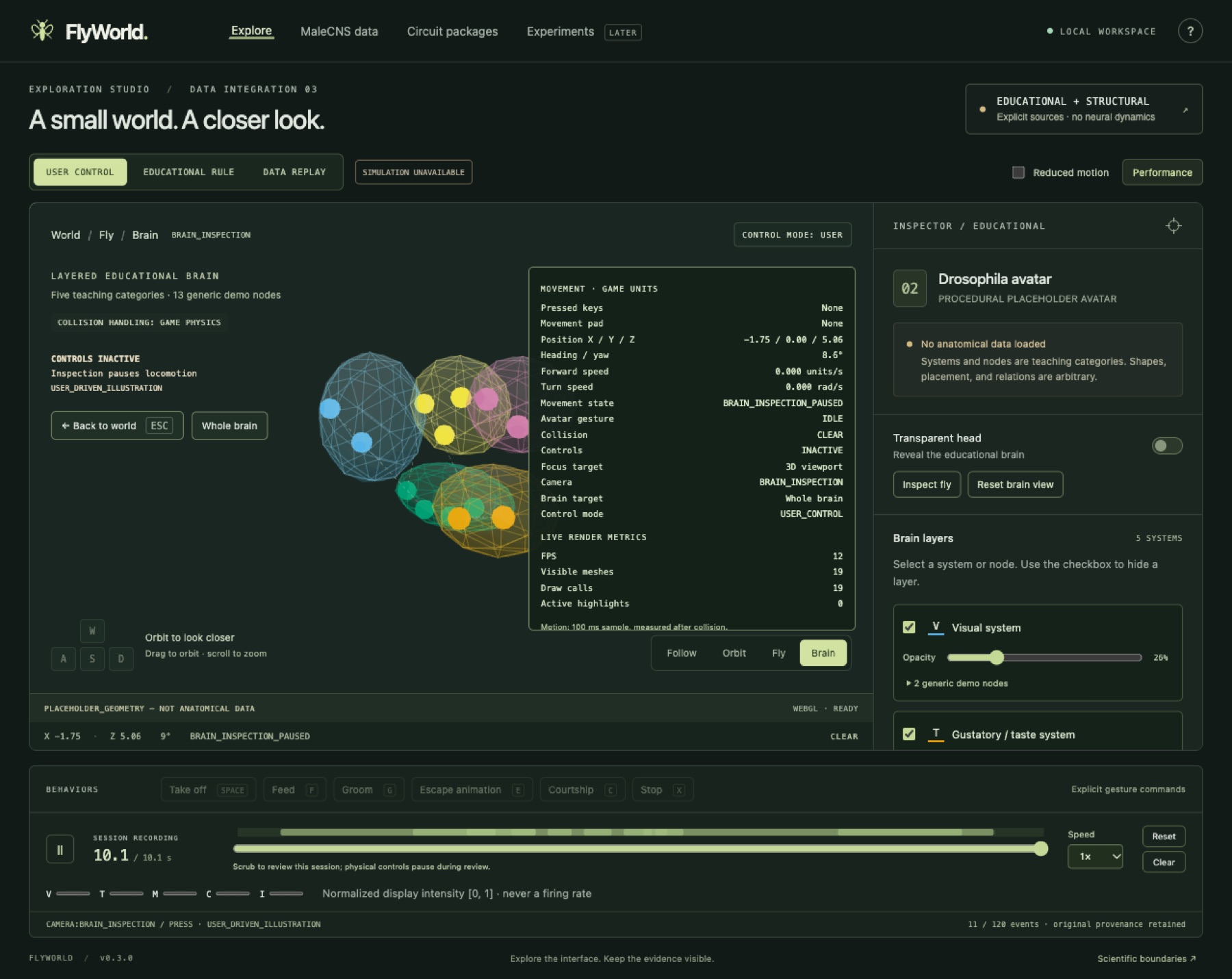
Click the viewport until it says CONTROLS ACTIVE. Hold W/S to walk, A/D to turn, Shift for 1.75× speed, Space to take off and land. F G E C play feed, groom, escape and a 2.4-second courtship wing display. B makes the head transparent; Tab inspects the brain's five teaching systems and 13 generic nodes. The timeline at the bottom replays a synthetic session; its intensities are normalised display values, never firing rates, and the interface says so.
MaleCNS data
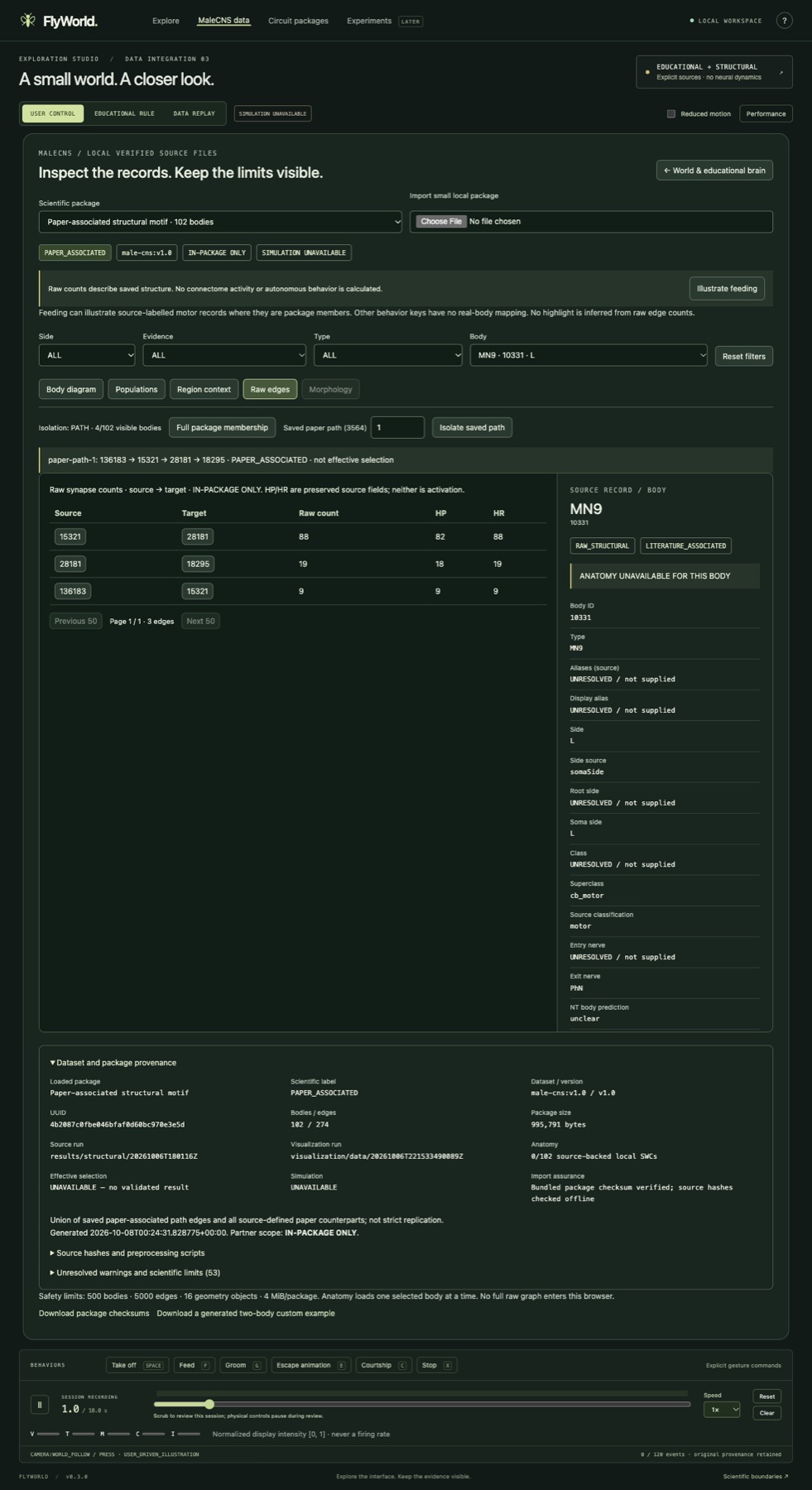
Switch to the real-source workspace and load a package: the focused set, the paper motif subset, the candidate bodies, LB3b, LB3c, the motors, the (empty) sugar selection, or the cached anatomy. Filter by side, type and evidence; isolate partners and paths; open the provenance inspector on any body to see which frozen file and hash each field came from. Partner totals are explicitly IN-PACKAGE ONLY. Custom JSON packages can be imported and are validated against the package schema; bad datasets, missing provenance, impossible counts and oversized files are rejected.
Hosted copy
The Real circuit anatomy atlas (search any of the 165,122 neurons, expand upstream and downstream partners, load recorded synapse sites) needs the local development server and its 1.5 GB SQLite index of all 25,563,197 connections. That index is not a browser asset, so the hosted copy shows a message when you open it. Everything else runs here as static files.
Where the data comes from
An offline preprocessor (Python standard library only, no network) reads the pinned MaleCNS flat files and the frozen structural results of the sugar circuit audit, verifies every input by SHA-256, and writes bounded JSON packages: at most 500 nodes, 5,000 edges, 4 MB. The verified source tuple is male-cns:v1.0 / v1.0 / 4b2087c0fbe046bfaf0d60bc970e3e5d. Scientific provenance stays separate from educational avatar behaviour: the FEED gesture can illustrate source-labelled motor neurons through a separately marked, unreviewed educational mapping, and the interface never implies that imported connectivity produced the behaviour.
| Package | Bodies | Raw edges | Label |
|---|---|---|---|
| Focused circuit | 110 | 1,923 | RAW_STRUCTURAL |
| Paper motif subset | 102 | 274 | PAPER_ASSOCIATED |
| Sugar-selected | 0 | 0 | awaiting validated results |
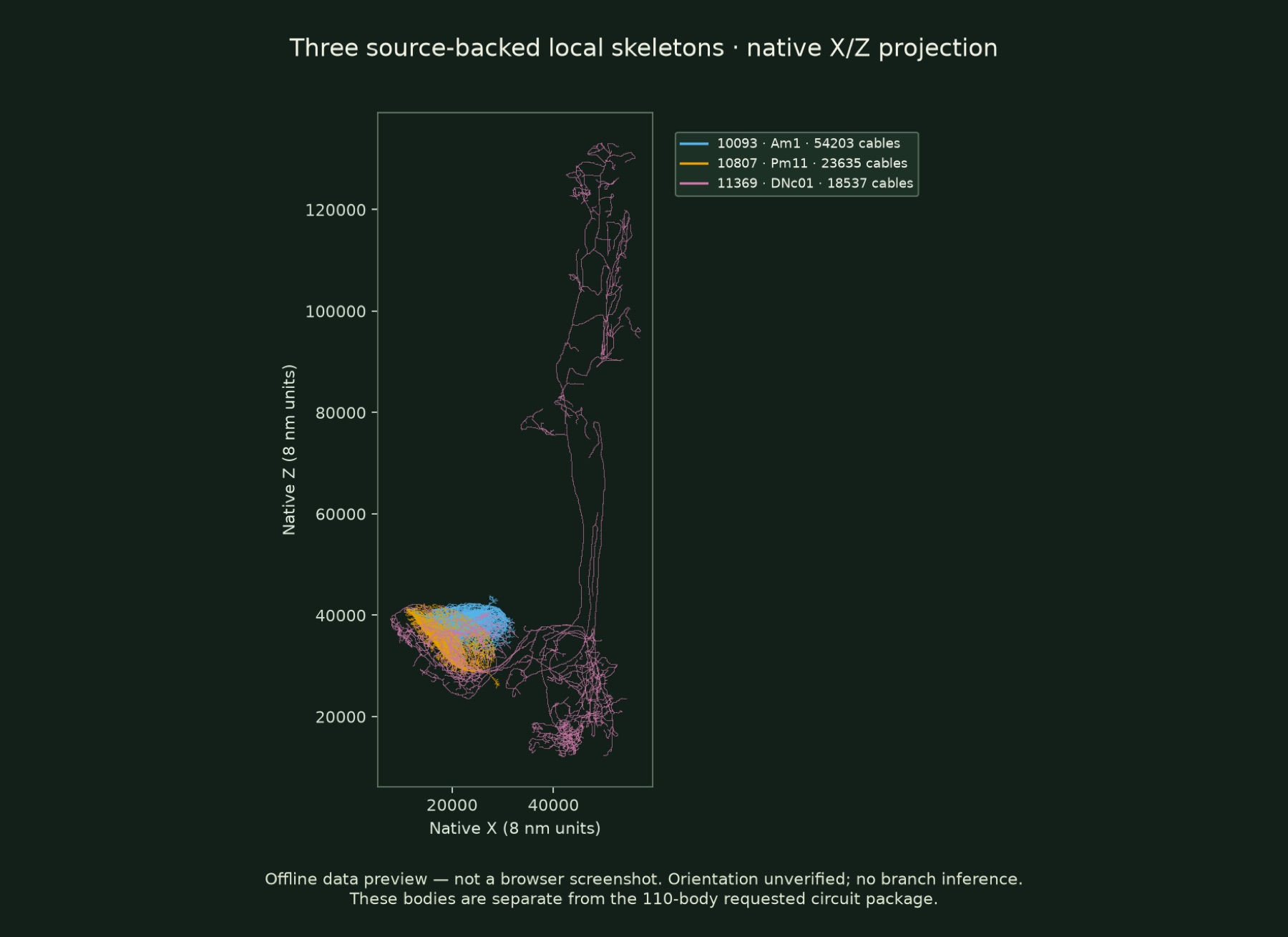
| Cached anatomy | 3 | 0 | ANATOMY_ONLY |
How it is built
React 19 with react-three-fiber for the world, zustand for studio state, zod for package validation. The connectome index for the atlas is a Vite dev-server plugin over node:sqlite, with neuroglancer's precomputed formats parsed in TypeScript for skeletons, meshes and synapse shards. 199 vitest tests cover the state machine, validation, controls and decoders; Playwright scenarios cover the browser flows. The checkpoint documents in docs/ record what each delivery contained, what was verified where, and what was left unresolved.
Run it locally
cd projects/flyworld-studio
npm ci
npm run dev           # http://127.0.0.1:5173
npm test              # 199 application tests
npm run build         # tsc + vite build
npm run index:connectome   # optional: build the 1.5 GB atlas index from the MaleCNS flat files
The hosted copy differs from the repository in one line: the build sets FLYWORLD_BASE=/flyworld/ so the app lives under this site, and asset fetches use that base.